A trustworthy mobile app development quote names every screen, states one pricing model and why, lists exclusions in writing, and tells you who on the team actually writes the code. If a quote skips any of those four things, you're looking at a guess dressed up as a number, and guesses turn into budget overruns three months into the build.
| What to Check | Good Sign | Red Flag |
|---|---|---|
| Scope of work | Screen-by-screen feature list with hours attached | One paragraph, one number |
| Pricing model | Named model (fixed, time & materials, dedicated team) with reasoning | No model stated, just a total |
| Platform breakdown | Cross-platform vs native costs itemised separately | "Mobile app" priced as one line |
| Exclusions | Written list of what's not included (maintenance, store fees, hosting) | Silence on exclusions |
| Ownership | Source code and store accounts transfer on final payment | Vague or missing IP clause |
| Team | Named developers, roles, and time commitment | "Our team" with no names |
| Discovery phase | A paid or scoped discovery step before the fixed number | Full quote from a single 40-minute call |
| Testing & QA | Dedicated QA time and device coverage listed | No mention of testing at all |
A real mobile app development quote is a document, not a single figure in an email. It opens with a detailed scope of work, breaks the build into features with time attached to each, states which pricing model applies, and lists what falls outside the price.
Every quote rests on a mental picture of your project: how many screens, how many user roles, which integrations, and how complex the design is. That picture shifts depending on whether your backend is a clean modern API or a decade-old system nobody has documented, and a serious quote should say which assumptions it made.
If two sections of the same document don't add up, the vendor hasn't actually scoped your app; they've applied a multiplier to a past project that looked similar. Ask them to walk through the reasoning behind one specific number. A vendor who scoped properly can explain it in two sentences.
A same-day quote almost always means the agency skipped scoping and reused a previous project's numbers. Genuine estimation involves someone asking what data you already have, who your users are, and which systems the app must talk to, and that takes longer than a single call.
If a firm can price your app inside a forty-minute conversation, it has pattern-matched your description against something it built before and applied a multiplier. That's a reasonable starting point for a ballpark, but it should never be presented as a final number, because genuine estimation is slow and somewhat boring. Push back if a "final" price shows up before anyone has asked about your data model or your existing systems.
The single biggest tell in a weak quote is a scope section that says "app development" with a dollar figure next to it, and nothing else. A strong quote lists each screen, each user role, each integration, and attaches an estimate to every one.
Ask for a feature table: login and onboarding, home feed, booking flow, payment screen, push notifications, admin dashboard. Each row should carry its own hours or cost range. This is the only way to spot where the money is actually going, and it's the same discipline we cover for web projects in how to vet a custom software quote before signing.
Two quotes for the "same app" can differ by tens of thousands because one vendor assumed a simple login screen and the other assumed social login, two-factor authentication, and a forgotten-password flow. Without a written breakdown, you can't tell which assumption you're paying for.
React Native lets one codebase run on both iOS and Android, which is why it usually costs less than building two separate native apps. But that saving only holds if your app doesn't lean heavily on native-only features.
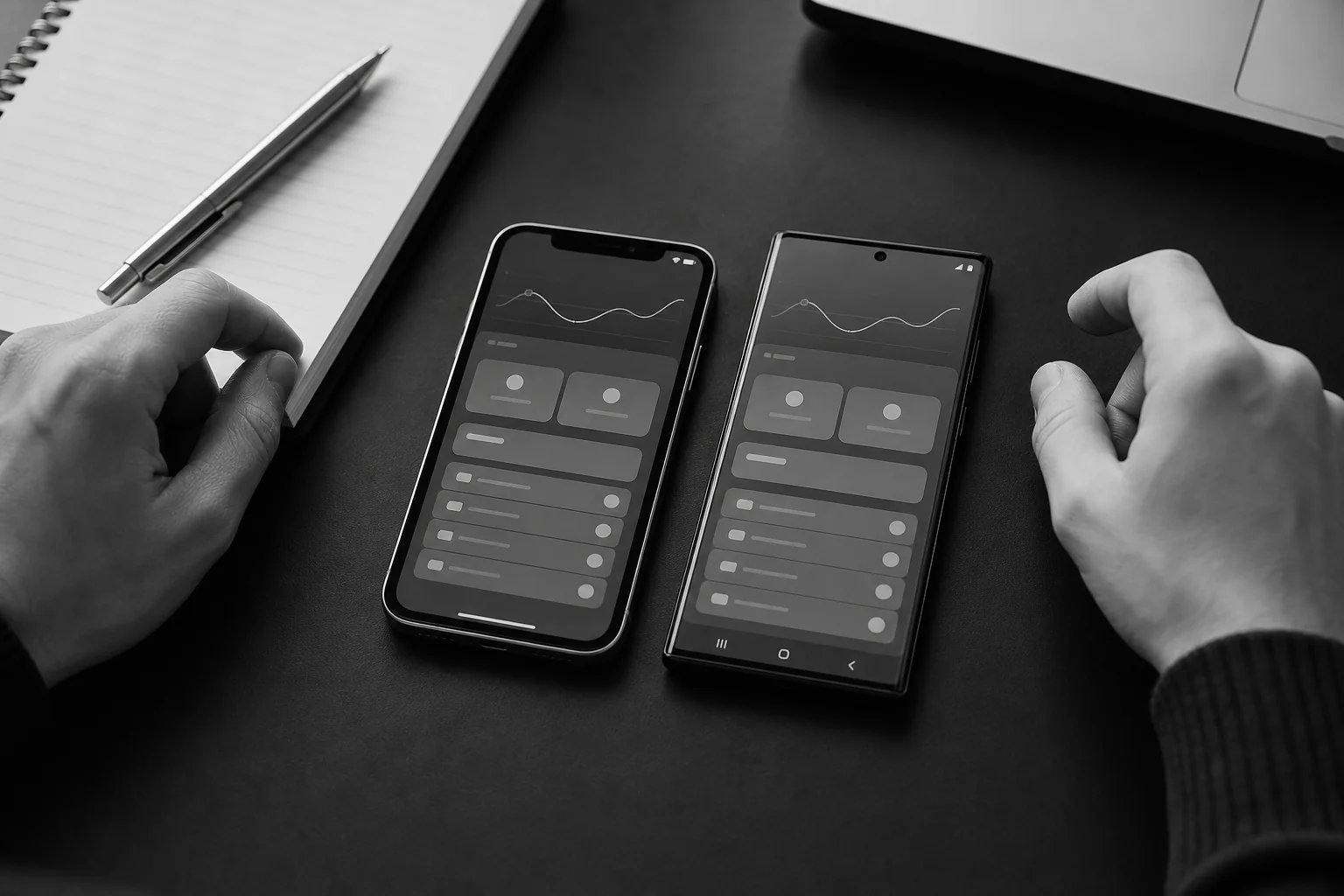
Apps built around background location tracking, complex camera processing, augmented reality, or deep Bluetooth-hardware integration often need native modules bolted onto React Native anyway, which narrows the cost gap. A quote should say explicitly which features, if any, will need native code even inside a cross-platform build.
When you're holding three quotes, one for React Native and two for native iOS and Android, don't compare the totals. Line up the same feature rows across all three documents and compare cost per feature. A native iOS quote that's cheaper overall but skips push notifications isn't actually cheaper once you add that scope back in.
If your team is weighing this decision more broadly, our breakdown on what to ask a React Native app development company before you sign covers the specific technical questions to raise before committing to either path. You can also read more about our cross-platform app development approach if you're deciding between architectures.
Native development still makes sense for apps that push hard on platform-specific hardware, like advanced camera capture, ARKit or ARCore features, or apps that need to feel indistinguishable from Apple's or Google's own design language. If your app is a standard CRUD app with forms, lists, and a booking flow, cross-platform almost always wins on cost and timeline.
The headline number in a quote rarely includes everything you'll actually pay before launch. Apple's developer account, Google Play's one-time registration fee, push notification infrastructure, and a device testing lab for real-hardware QA often sit outside the main price.
Ask directly: what happens if Apple rejects the build during App Store review? A serious vendor will have a plan for resubmission built into the timeline, not an open-ended "we'll fix it" with no cost attached. The quotation itself should open with a full scope of work that names these dependencies rather than leaving them as surprises after signing.
Backend hosting, ongoing maintenance, and third-party API fees (payment gateways, mapping services, SMS providers) are three more line items that frequently appear only in the fine print, or not at all. Ask for a written list of exclusions before you sign anything.
A cheap quote that doesn't hand you the source code isn't actually cheap. Confirm in writing that you own the codebase, the design files, and the app store developer accounts once the final invoice is paid.
Some vendors build on shared or agency-owned developer accounts, which means switching providers later can mean losing your app's reviews, ratings, and store history. Ask specifically who holds the Apple and Google developer accounts your app will ship under.
The clauses covering IP transfer, source code escrow, and what happens if either side ends the engagement early deserve their own read separate from the pricing table. Our guide on development contract essentials and the 11 clauses to review before signing walks through exactly what those terms should say.
A quote that talks about "our team" without naming a single person is telling you nothing about who will actually touch your codebase. Ask for the names, roles, and rough time commitment of the developers assigned to your project.
Reference calls matter here too. A thorough vetting process runs "through initial portfolio review, technical assessment, and reference calls" before a contract is signed, not after work has already started. This kind of check separates agencies who can deliver from agencies who can sell.
Subcontracting is common in this industry and isn't automatically a problem, but it should be disclosed. If the agency plans to bring in outside contractors for parts of the build, you deserve to know that before you sign, not after a delay reveals it.
You compare them by normalising both to a cost-per-feature basis, not by comparing the bottom-line totals. Fixed price, time and materials, and dedicated team models each shift risk differently, and a lower total under one model can hide more exposure than a higher total under another.

Fixed price puts the estimation risk on the vendor and works best when the scope is genuinely locked. Time and materials shifts that risk to you, the client, and only makes sense when you have someone in-house tracking hours against output. A dedicated team model bills a monthly rate for a set group of people regardless of output, which suits longer, evolving builds better than a one-off app.
List the same ten or twelve features across every quote you receive, then divide each vendor's total by that feature count. A fixed-price quote that's 15% higher but covers testing, App Store submission, and two rounds of revisions is usually the better deal over a time-and-materials quote that looks cheaper on page one.
Nine-step evaluation frameworks used by procurement teams start with one question: does the proposal show a clear understanding of your product, before anyone even looks at the timeline or the cost? If the answer's no, the number underneath doesn't matter, according to step-by-step proposal evaluation guidance built for exactly this situation.
Mobile app quotes carry vetting concerns a web app quote doesn't: app store review timelines, per-platform testing devices, and push notification infrastructure all sit outside a typical web quote's scope. A web app, by contrast, needs closer scrutiny on hosting, browser compatibility, and SEO deliverables.
If you're weighing a companion web platform alongside your mobile build, the equivalent line-by-line checklist for that side of the project is covered in how to vet a custom software quote before signing. Many founders end up comparing both quote types in the same week, and the underlying discipline, name every feature, name every exclusion, name every person, holds for both.
An app discovery phase is a scoped block of work where the vendor maps your requirements, user flows, and technical constraints before committing to a fixed price. It should appear as its own line item, either free as a sales step or paid as a short, separate engagement, and its output should be the document the rest of the quote is built from.
A properly scoped quote typically takes several days to two weeks, depending on project complexity, because the vendor needs to ask questions, review any existing systems, and break the build into estimable pieces. Anything delivered same-day for a non-trivial app should be treated as a rough estimate, not a number to sign against.
Yes, comparing quotes across regions, including agencies based in the UK, Ireland, the Netherlands, and India, gives you a realistic range for your project and exposes vendors whose pricing sits far outside the norm in either direction. Rate differences between regions are real and often reflect overhead rather than skill, but scope and ownership terms still need the same scrutiny regardless of where the team is based.
You can get a directionally accurate range, but a fully accurate fixed-price quote needs wireframes or a clickable prototype first, since screen count and interaction complexity drive most of the estimate. If your design isn't ready, ask the vendor to quote the discovery and design phase separately from the development phase.
Vetting a mobile app quote properly takes an afternoon of reading, and it's the cheapest insurance you'll buy on the entire project. If you'd rather skip the guesswork, Axire Infotech scopes React Native and native builds with a full feature breakdown before we name a price.
Get in touch to walk through your app idea and see what a properly scoped quote actually looks like, or browse our past projects to see the kind of builds we've delivered for European startups and SMBs.
Let's discuss your project and create something amazing together.
