A clinic booking app and a restaurant booking app solve the same surface problem, taking a reservation, but they need almost opposite data models underneath. A clinic system revolves around a recurring patient-practitioner relationship with fixed treatment durations, while a restaurant system revolves around table turnover, party size, and walk-in variability. Build one to fit the other's use case and you'll spend the next year patching around the mismatch.
| Requirement | Clinic Booking App | Restaurant Booking App |
|---|---|---|
| Core bookable unit | Practitioner time slot | Table or seating block |
| Typical duration | Fixed by treatment type (15-60 min) | Variable, estimated by party size and course count |
| Recurrence | Common (weekly/monthly follow-ups) | Rare (special occasions aside) |
| No-show mitigation | Deposits, reminders, waitlist backfill | Card holds, overbooking buffers, walk-in absorption |
| Core integration | Practice management software or EHR | POS and kitchen display system |
| Compliance load | Patient data, higher privacy bar | Payment data (PSD2/SCA in Europe) |
| Peak demand pattern | Spread across business hours | Concentrated around lunch/dinner windows |
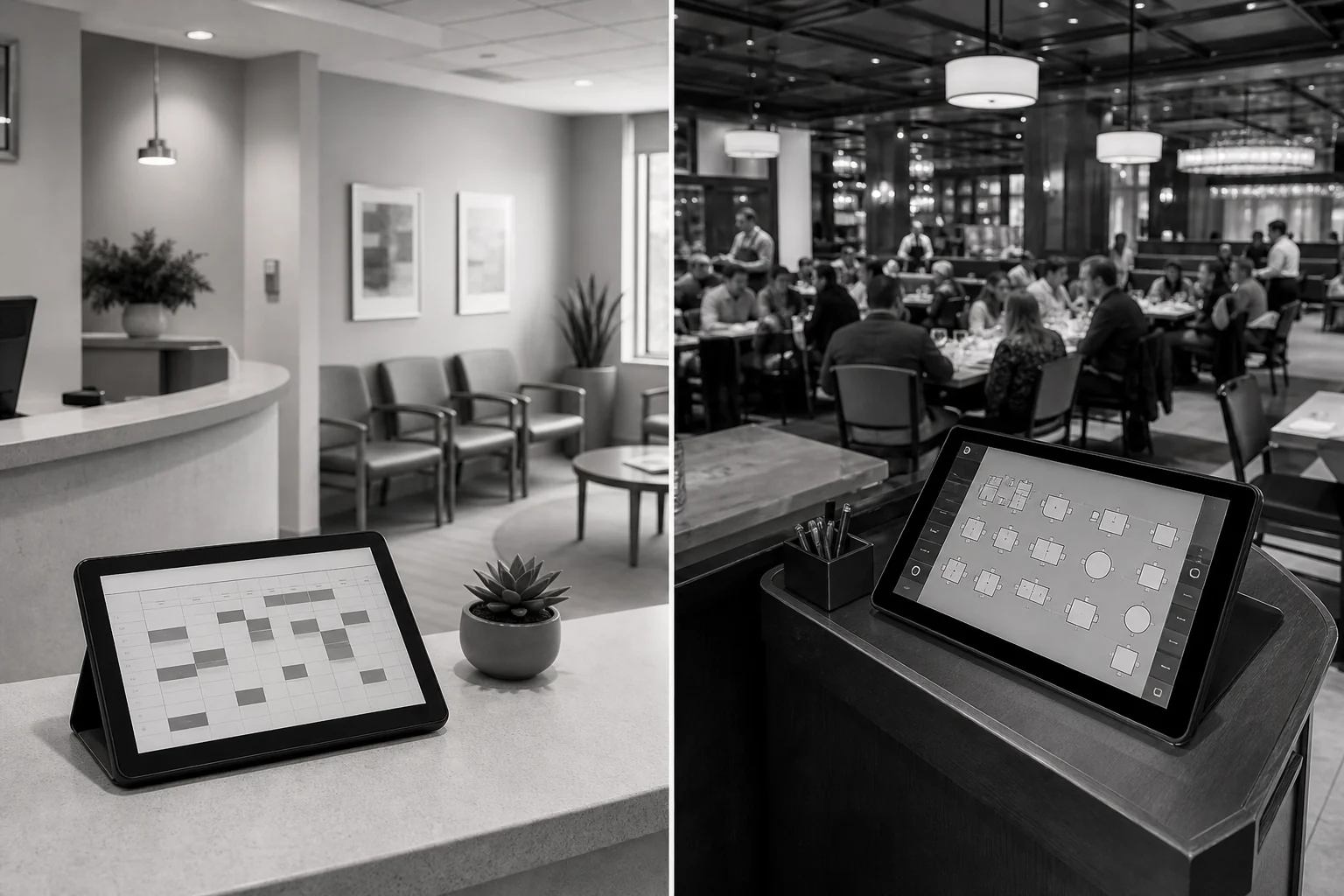
A booking system built for a clinic and dropped into a restaurant will fail in a specific, predictable way: it will let a host book a four-top for six people, because the schema never treated table capacity as a hard constraint the way it treats appointment duration.
The reverse mismatch is just as common. A restaurant-style booking tool given to a physiotherapy clinic will happily double-book a therapist because it was built to overbook tables on purpose. Overbooking is a feature in hospitality and a compliance risk in healthcare.
This isn't a UI problem you can theme your way around. It's a data model problem, and it shows up first in how the system defines its central entity: is it a person's calendar, or a piece of physical inventory with a capacity number attached?
Clinic scheduling treats the appointment as what one architecture write-up on a dental booking platform calls an entity with its own identity and lifecycle: requested, confirmed, completed, cancelled, independent of which calendar stores it. The time slot and service type are attached as supporting values, not the main object.
That structure supports what clinics actually need: a patient tied to a specific practitioner over multiple visits, treatment-specific duration rules, and a record that persists even if the calendar backend changes. Recurring appointments, follow-ups, and multi-session treatment plans all hang off that same entity.

Restaurant scheduling flips the priority. The table (or a group of tables that can be combined) is the resource, and its capacity is the hard constraint. A booking for six people simply cannot attach to a table rated for four, no matter how the time slot looks.
Duration is also probabilistic rather than fixed. A two-hour dinner reservation might turn over in ninety minutes on a quiet Tuesday or run past midnight on a busy Saturday, so the system needs turnover estimates and a live floor view, not a fixed 30-minute grid like a clinic calendar.
The practical rule: if your business books people's time, model the practitioner as the resource. If your business books physical space, model the space as the resource with a capacity field. Retrofitting one into the other later is a rebuild, not a patch.
Clinics prevent no-shows with deposits, automated SMS or WhatsApp reminders, and a waitlist that backfills a cancelled slot within minutes; restaurants instead use card-on-file holds and deliberate overbooking buffers, because an empty table costs less to recover than an empty consultation hour.
A missed medical appointment doesn't just lose revenue. It leaves a practitioner idle for a fixed block that can't easily be filled on short notice, which is why clinic apps lean hard on automated reminders and cancellation windows. Our own breakdown of clinic booking app development and no-show reduction covers the reminder cadence and deposit logic in more depth.
Restaurants play a volume game instead. A no-show on a two-top rarely matters if the host can seat a walk-in within ten minutes, so the smarter systems deliberately overbook by a small percentage during peak service and lean on a real-time waitlist to absorb the difference.
Salons and spas sit somewhere between the two, with fixed-duration bookings like a clinic but softer compliance requirements, which is worth reading separately if that's your vertical: see our salon and spa booking app guide for how that hybrid model gets built.
A clinic booking app earns its value from syncing with practice management software or an EHR, plus calendar tools like Google Calendar or Outlook for practitioners who split time across locations. Payment integration is usually limited to consult fees or deposits.
A restaurant booking app earns its value somewhere else entirely: the point-of-sale system, the kitchen display system, and increasingly a delivery aggregator feed if the same floor also handles takeout orders. None of that matters to a clinic, and none of a clinic's EHR concerns matter to a restaurant.
Where the two verticals genuinely overlap is payment compliance. Both need PSD2/SCA-ready payment handling in European markets, whether that's a consult deposit or a table-hold charge, and both benefit from the same underlying PSD2-compliant payment gateway integration pattern even though the trigger event differs.
For businesses running loyalty programs or multi-location reporting on either side, a CRM connection is often the second integration that gets requested six months after launch, which is why we scope for it up front rather than bolting it on; our CRM integration setup guide walks through that connection point.
For a booking platform, discovery means mapping every entity (patient, practitioner, table, party), every role (admin, staff, customer), and every edge case (double-booking, group splits, recurring visits) before a single wireframe gets drawn. Skipping it is the single biggest cause of expensive schema rewrites after launch.
This is the phase where the clinic-vs-restaurant distinction actually gets decided in practice, not in a blog post. A discovery session for a multi-location physiotherapy group will surface recurring visit patterns and referral workflows that never come up in a restaurant kickoff call, and vice versa for split-bill logic or delivery zone rules.
If you want the full mechanics of how that phase runs, we've written it up separately in our discovery phase in app development guide, which covers the specific deliverables you should expect to walk away with.
The smartest move for an SMB that might grow into a second vertical, or a platform vendor serving both, is to model the "resource" as a configurable object from day one: an abstract bookable unit with fields like capacity, duration rules, and assigned staff, rather than hardcoding "table" or "practitioner" into the database schema.
Role-based access control matters early too. A clinic needs to separate what a receptionist, a practitioner, and an admin can each see and edit; a restaurant needs the same separation between a host, a server, and a manager. Get RBAC wrong at the start and every later feature has to work around it.
If your business is scaling past a single location, this is also where a custom web app development cost breakdown becomes useful reading, since multi-location booking logic changes the estimate meaningfully compared to a single-site build.
Consider a hypothetical multi-practitioner physiotherapy clinic and a 60-seat bistro, both approaching the same development team with "we need a booking app." The discovery calls would diverge within the first hour.
For the clinic, the team would map recurring six-week treatment plans, insurance-linked billing codes, and a waitlist that texts the next patient the moment a slot opens. The core object is the appointment, and the practitioner's calendar is the constraint.
For the bistro, the team would map peak-hour table combinations, a deposit rule for parties over eight, and a live floor view synced to the POS so a server never double-seats a table the host already gave away. The core object is the table, and capacity is the constraint.
Both builds could reuse the same underlying booking engine and the same React Native front end pattern. Neither could reuse the other's database schema without a rewrite.
Ask a prospective agency one question before anything else: "walk me through how your booking engine handles capacity constraints differently from time-slot constraints." A vague answer means they'll build you a generic form, not an architecture that fits your business.
Axire Infotech's development team works across both patterns, backed by full-stack developers on React, Node.js, and React Native, with a design team that maps user roles in Figma before a line of code gets written. The app development team handles cross-platform builds so a clinic or restaurant app runs natively on iOS and Android from one codebase.
Businesses serving the UK, Ireland, and wider Europe often ask about sprint reporting transparency before committing to an offshore partner, and that's a fair ask: a booking platform touches patient or payment data, so you want visibility into what shipped each week, not a black box until launch. Our guide to choosing a web app development agency lists the specific questions worth asking on that front.
If you're still scoping which features actually belong in a first release, our UI/UX design service starts with the same discovery-first mapping described above, before wireframes get touched.
Whether you're running a clinic, a restaurant, or a platform that needs to serve both, the fix is the same: get the resource model right before the interface. Contact Axire Infotech for a discovery call scoped to your specific booking use case, or browse our past projects to see how the same engineering process adapts across industries.
Let's discuss your project and create something amazing together.
